You Won’t Believe What Skopje’s Cityscape Just Revealed
Skopje, the capital of North Macedonia, surprised me in ways I never expected. From its bold mix of neoclassical monuments to Ottoman-era streets, the city feels like a living collage. As I checked in and wandered through its evolving skyline, I realized this wasn’t just a stopover—it was a story written in stone, color, and quiet resilience. The cityscape here doesn’t shout; it whispers with character, waiting to be noticed. With every turn, layers of history emerge not as relics behind glass, but as active elements shaping daily life. This is a city unafraid of contrast, where ancient alleys meet grand plazas, and where the past is not preserved in silence, but spoken through architecture, light, and local rhythm.
First Impressions: Arriving in Skopje
Touching down at Skopje International Airport, the first view of the city unfolds gently against a backdrop of surrounding hills. The approach is unassuming—no sprawling metropolis skyline dominates the horizon. Instead, a patchwork of red-tiled roofs, modern apartment blocks, and distant spires hints at a place shaped by both time and transformation. As the taxi winds along the highway into the city center, the Vardar River appears like a silver thread guiding the way. Along its banks, new developments stand beside older neighborhoods, each layer telling a different chapter of Skopje’s story.
Many travelers arrive with modest expectations, perhaps viewing Skopje as a transit point rather than a destination. Yet within minutes of entering the city, the energy shifts. Street art decorates concrete walls, café terraces buzz with conversation, and the faint scent of fresh bread drifts from corner bakeries. This is not a city asleep, but one quietly awake, redefining itself with deliberate steps. The initial contrast between modern infrastructure and visible historical traces is striking—ancient fortifications sit above new shopping centers, and Ottoman-era mosques rise just blocks from government buildings adorned with classical columns.
What becomes clear early on is that Skopje does not conform to typical European capital aesthetics. It does not aim for polished uniformity. Instead, it embraces juxtaposition—sometimes boldly, sometimes subtly. The city’s charm lies not in perfection, but in authenticity. Visitors who expect grand cathedrals or sweeping boulevards may be surprised. But those who come with curiosity are rewarded with a sense of discovery, as if uncovering a secret that the rest of Europe has overlooked. This duality—between expectation and reality—forms the foundation of Skopje’s unique appeal.
The Heart of the City: Macedonia Square and Its Monuments
At the core of Skopje’s urban identity lies Macedonia Square, a vast public space that functions as both a gathering place and a visual narrative of national pride. Dominated by grand statues, fountains, and neoclassical facades, the square feels more like an open-air museum than a traditional city center. The most prominent feature is the massive statue of a warrior on horseback, officially named Warrior on a Horse but widely believed to represent Alexander the Great. Standing tall on a high pedestal, the figure gazes northward, cloaked in bronze and controversy. While the identity remains officially ambiguous due to regional sensitivities, the symbolism is unmistakable—a nod to ancient heritage and a declaration of cultural continuity.
Surrounding the statue, the square unfolds in symmetrical grandeur. Baroque-style columns, arched walkways, and marble staircases create a theatrical atmosphere, reminiscent of capitals like Vienna or Bucharest. Fountains spray water in rhythmic patterns, their reflections shimmering under sunlight. Yet this opulence exists alongside more modest elements—the chatter of locals, children chasing pigeons, vendors selling roasted corn. The space is both ceremonial and lived-in, a rare balance between monumentality and accessibility.
What makes Macedonia Square particularly fascinating is its architectural eclecticism. Within a single view, one can see socialist-era buildings with utilitarian lines, Ottoman influences in nearby mosques, and 21st-century reconstructions clad in stone and gold leaf. This blend is not accidental. It reflects a deliberate effort to reconstruct Skopje’s identity after the devastating 1963 earthquake, which destroyed much of the city. The recent Skopje 2014 project further amplified this vision, introducing over 20 new monuments and façades designed to evoke classical antiquity. While critics argue about historical accuracy and cost, the result is undeniably striking—a cityscape that dares to be bold, even if it divides opinion.
Crossing Time: The Stone Bridge as a Symbolic Divide
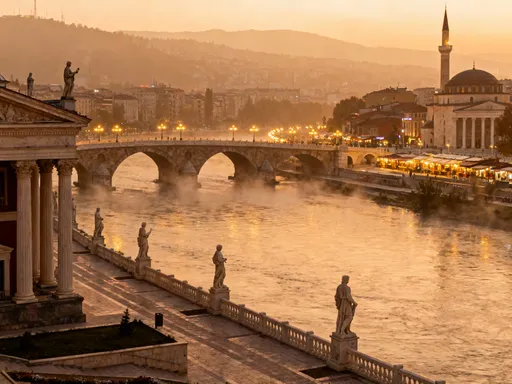
Spanning the Vardar River, the Stone Bridge is one of Skopje’s oldest and most enduring landmarks. Built in the 15th century during Ottoman rule, this 21-arched structure connects the modern city center with the historic Old Bazaar district. More than just a crossing, it serves as a symbolic threshold between eras. With each step across its weathered stones, one moves from neoclassical plazas into narrow cobbled lanes where time seems to slow. The bridge itself has witnessed centuries of change—earthquakes, wars, reconstruction—and yet it remains intact, a testament to resilience.
At sunrise, the Stone Bridge offers one of Skopje’s most poetic views. Mist rises from the river, softening the outlines of distant hills, while the first light catches the golden domes of nearby buildings. The city awakens gently, with joggers, photographers, and early risers pausing to take in the panorama. By sunset, the mood shifts. The sky turns amber and rose, casting long shadows across the water. The bridge becomes a silhouette, framed by illuminated statues and the glow of streetlamps. These quiet moments reveal a different side of Skopje—one of serenity and reflection, far removed from the daytime bustle.
The Stone Bridge also plays a crucial role in connecting communities. On the west bank, government buildings and modern cafes reflect Skopje’s contemporary aspirations. On the east, the Old Bazaar pulses with traditional life—artisans shaping copper, shopkeepers calling out greetings, the scent of spices filling the air. The bridge links these worlds, allowing visitors and residents alike to experience both sides of the city’s identity. It is not merely a physical passage, but a cultural bridge—one that invites dialogue between past and present, local and global, tradition and innovation.
Old Bazaar: A Living Heritage Landscape
The Old Bazaar, or Stara Čaršija, is one of the oldest and largest market districts in the Balkans, with roots stretching back over 500 years. Walking into this labyrinth of stone pathways and low-slung buildings feels like stepping into another era. The air is rich with the aroma of grilled meat, fresh herbs, and warm pastries. Shopfronts display handwoven textiles, intricately carved wooden boxes, and gleaming metalwork. Men in traditional attire sip coffee in shaded courtyards, while artisans tap hammers against copper in open-air workshops. This is not a recreated tourist zone, but a functioning neighborhood where history is lived, not staged.
What sets the Old Bazaar apart is its authenticity. Unlike sanitized heritage sites found in other European cities, this district remains deeply embedded in daily life. Families run multi-generational businesses. Children play near doorways while elders chat on benches. Religious and cultural diversity is evident in the proximity of mosques, churches, and historic inns. The Mustafa Pasha Mosque, perched on a hillside, offers panoramic views of the bazaar below, its slender minaret a constant presence in the skyline. The Sultan Murad Mosque, one of the oldest in the city, stands as a quiet guardian of centuries-old traditions.
Preservation efforts have helped maintain the bazaar’s integrity without freezing it in time. Restoration projects have repaired damaged structures while respecting original materials and techniques. At the same time, new businesses—art galleries, craft cafes, design studios—have found a home here, creating a dynamic blend of old and new. This balance ensures that the Old Bazaar remains relevant, not just as a tourist attraction, but as a vital urban space. For visitors, it offers more than souvenirs—it provides a sensory immersion into the rhythms of local life. To walk through the bazaar is to understand that heritage is not just about monuments, but about continuity, community, and craft.
Urban Layers: Architecture That Tells a Story
Skopje’s architectural landscape is a palimpsest—a surface where multiple narratives are written over one another. The 1963 earthquake, which killed over a thousand people and left most of the city in ruins, became a turning point in its urban development. The reconstruction that followed introduced modernist and socialist architecture, characterized by functional apartment blocks and wide boulevards. These structures, though often criticized for their austerity, reflect a period of resilience and collective rebuilding. Today, they form the backbone of many residential neighborhoods, housing generations of Skopje’s citizens.
In the 2010s, the Skopje 2014 initiative dramatically altered the city’s aesthetic. At a cost of over 500 million euros, the project introduced neoclassical and baroque-style buildings, triumphal arches, and dozens of statues. The Porta Macedonia, a monumental arch adorned with reliefs, stands as a gateway to the city center, commemorating national milestones. The Museum of the Macedonian Struggle, redesigned with Greco-Roman columns and sculpted friezes, presents history through a highly visual lens. These additions were intended to strengthen national identity and boost tourism, but they also sparked debate. Critics argue that the style is kitsch, historically inaccurate, or financially irresponsible. Supporters, however, see them as a source of pride and a way to reclaim cultural visibility.
Regardless of perspective, the visual impact is undeniable. The cityscape now features a theatrical grandeur rarely seen in the region. Statues of philosophers, revolutionaries, and mythical figures line the streets, creating a sense of historical procession. Gold-leaf domes catch the sunlight, while fountains and colonnades add a sense of ceremony to public spaces. This architectural boldness may not appeal to minimalist tastes, but it reflects a city unafraid to express itself. In a continent where many capitals conform to similar styles, Skopje chooses distinction over discretion. The layers—Ottoman, socialist, neoclassical—do not erase one another, but coexist in a complex, sometimes chaotic, but always compelling dialogue.
Hidden Corners: Off-the-Beaten-Path Views
Beyond the main squares and tourist trails, Skopje reveals quieter, more intimate dimensions. Neighborhoods like Debar Maalo and Karpoš offer a different pace and perspective. Debar Maalo, nestled at the foot of Skopje Fortress, was once a historic Muslim quarter. Today, its narrow streets are lined with colorful houses, climbing vines, and small family-run cafes. The atmosphere is relaxed, almost village-like, despite being just minutes from the city center. Locals gather in courtyards, playing board games or sipping herbal tea. Street art blends with traditional motifs, creating a sense of cultural fusion that feels organic rather than staged.
Karpoš, a residential district to the northeast, showcases everyday Skopje life. Here, Soviet-era apartment blocks are softened by flower boxes, children’s drawings in windows, and laundry hanging between buildings. Community gardens and small parks provide green oases amid concrete. While not picturesque in the conventional sense, these areas offer authenticity. They remind visitors that cities are not just monuments and museums, but homes. Exploring them requires no itinerary—just willingness to wander, observe, and connect.
For those seeking unique vantage points, the hills surrounding Skopje offer rewarding views. A short hike up to the Millennium Cross on Mount Vodno provides a panoramic overlook of the entire city. From this height, the Vardar River snakes through the urban fabric, connecting old and new in a single glance. The fortress walls, glowing in the afternoon sun, stand as a crown above the skyline. Another lesser-known spot is the pedestrian path along the river’s east bank, where locals walk, cycle, and picnic. At dusk, the illuminated bridges and buildings create a gentle glow, reflecting off the water like scattered stars. These hidden corners do not appear in every guidebook, but they often leave the deepest impressions.
Sunset to Night: How the City Transforms After Dark
As daylight fades, Skopje undergoes a subtle but profound transformation. The golden hues of sunset give way to a cooler palette—deep blues, soft purples, and the warm amber of streetlights. The city does not shut down; instead, it shifts gears. Cafés and restaurants along the riverfront light up, their terraces filling with diners and friends sharing stories. Music drifts from outdoor bars, blending with the murmur of conversation and the occasional chime of a passing tram.
One of the most striking features of Skopje at night is its lighting design. Monuments are carefully illuminated to highlight architectural details. The Stone Bridge glows from below, its arches casting elegant reflections on the Vardar. Statues in Macedonia Square are lit like stage performers, their silhouettes sharp against the dark sky. The Porta Macedonia shines in warm gold, while the fountain in front dances with colored lights. This attention to nocturnal aesthetics enhances the city’s dramatic character, making evening walks a visual delight.
Public art also comes alive after dark. Light installations, temporary exhibits, and projection mappings occasionally appear on building façades, adding a modern artistic layer to the historic backdrop. These moments turn the city into a canvas, blending technology with tradition. Even the fortress, perched high above, is softly lit, its walls visible from miles away. For visitors, experiencing Skopje at night adds depth to their understanding. It reveals a different rhythm—one that is calmer, more reflective, yet still vibrant. The city’s energy does not disappear; it simply changes form, inviting a slower, more contemplative way of seeing.
Skopje’s cityscape is more than a collection of buildings—it’s a narrative of resilience, identity, and reinvention. By checking in with intention and curiosity, travelers gain not just views, but insight. This city invites you to look closer, question assumptions, and find beauty in complexity. In a world of cookie-cutter capitals, Skopje stands unapologetically itself—and that’s exactly why it’s worth seeing.